


Jan - May 2023

Customer Support Initiative Roadmap

Customer support operations were fragmented across workflows, tools, and teams—leading to inconsistent resolution, operational inefficiencies, and poor customer experience. This project focused on defining a structured roadmap to align support as a scalable, high-impact service.

Design Strategy
Product Management
Customer Experience (CX)

Project Overview

⚔️ The Challenge

The Customer Support Initiative lacked a clear direction, structured milestones, and a focused strategy for enhancing user experiences and support process. Without a defined roadmap, improvement efforts across customers, couriers, partners, and internal support teams were fragmented and reactive.


  • Fragmented support channels
  • Inefficient ticket routing
  • Lack of visibility across journeys
  • Agent friction in workflows

It became necessary to establish a structured, forward-looking roadmap that not only organized the initiative’s milestones but also ensured alignment with MRSOOL’s overarching product vision and strategic goals — driving more cohesive, impactful enhancements across the support ecosystem.

👥 Target Users

Primary Users:

  • Internal Support Teams (Support Agents, Ops Team, Support Management)
  • Cross-functional Teams involved in delivering and improving the support experience (Product, UX, Engineering, and Business Teams)

Indirect Users:

  • MRSOOL Customers, Couriers, and Partners and Merchants (Users impacted by the improvements made to the support processes and systems)

📌 Scope

  • Led the initiative end-to-end, including research, problem framing, roadmap definition, and stakeholder alignment.
  • Design a comprehensive UX Roadmap for the Customer Support Initiative, outlining current pain points, defining milestone projects, and shaping future-state goals. The roadmap aligns all support-related activities with MRSOOL’s broader product vision, providing internal teams with clear direction while ultimately improving the support experience for customers, couriers, partners, and merchants.

🌟 The Opportunity

How might we create a clear, strategic roadmap that empowers internal teams to deliver better support experiences — while ensuring all improvements align with MRSOOL’s vision for a seamless, scalable, and user-centric product?

🏆 Accomplishments and Impact

  • Established strategic alignment and positioned support as a strategic funtion, not just reactive
    Connected the Customer Support Initiative directly to MRSOOL’s overarching vision, mission, and North Star metrics, ensuring that all future efforts were strategically grounded.
  • Created a future-focused Roadmap and clear direction for support transformation
    Designed a comprehensive UX Roadmap that clearly mapped current and future support milestones, guiding teams toward long-term improvements with defined direction and focus.
  • Built a scalable roadmap system
    Designed a structured project template in Notion to systematically define project types, users, dependencies, blockers, risks, and prioritization — creating a sustainable framework for managing and growing the initiative.
  • Improved Prioritization and Decision-Making
    Applied a structured prioritization framework to sort projects by clarity and risk, helping the team focus resources efficiently and tackle the most critical challenges first.
  • Set a clear foundation for future enhancements
    Positioned the Customer Support Initiative for continuous growth, providing a baseline for future planning, execution, and strategic scaling across the support ecosystem.

🔍 Research & Alignment

1. Desk Research

Conducted desk research across internal strategy materials (vision, North Star metrics, customer and partner promises, and support workflows workshop outcomes) to align the Support Initiative with broader business objectives and success metrics.

2. User Research

This was complemented by synthesizing existing user research across all service actors—customers, couriers, partners, and internal teams—revealing systemic gaps across the support experience.
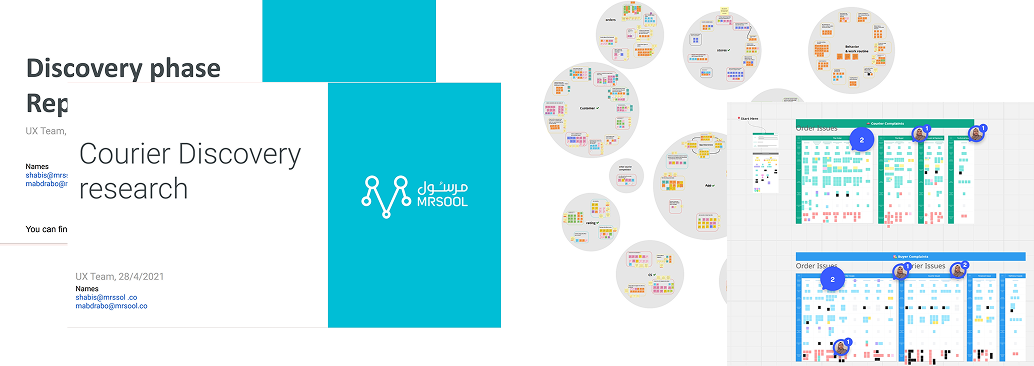
Research Inputs and Sources

This stage established a shared strategic direction for support as a cross-functional service and connected support initiatives to business outcomes, not isolated improvements.

Constraint and Tradeoff: Relied on existing research and fragmented internal sources, requiring synthesis rather than net-new discovery

🧩 Defining the Problem Space

This stage created clarity across scattered initiatives and overlapping efforts, through Identification of high-impact gaps and avoided duplicating ongoing work.

1. Set Support Initiative Objectives and Goals

Mapped Support Initiative objectives by aligning user needs, operational gaps, and business priorities.
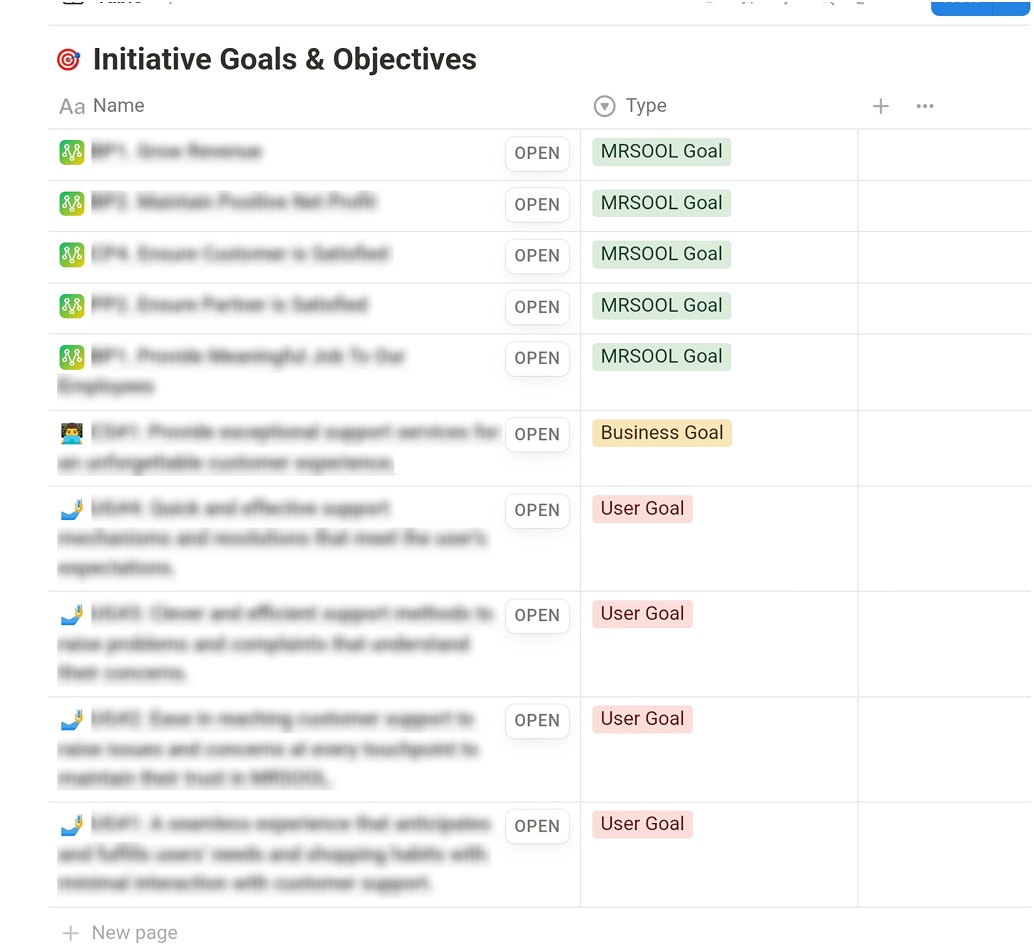
Support Initiative and Organization Objectives
2. Understand the Current State of the Initiative

Audited ongoing efforts through tools like Notion and Jira, conducting a lightweight retrospective to understand:
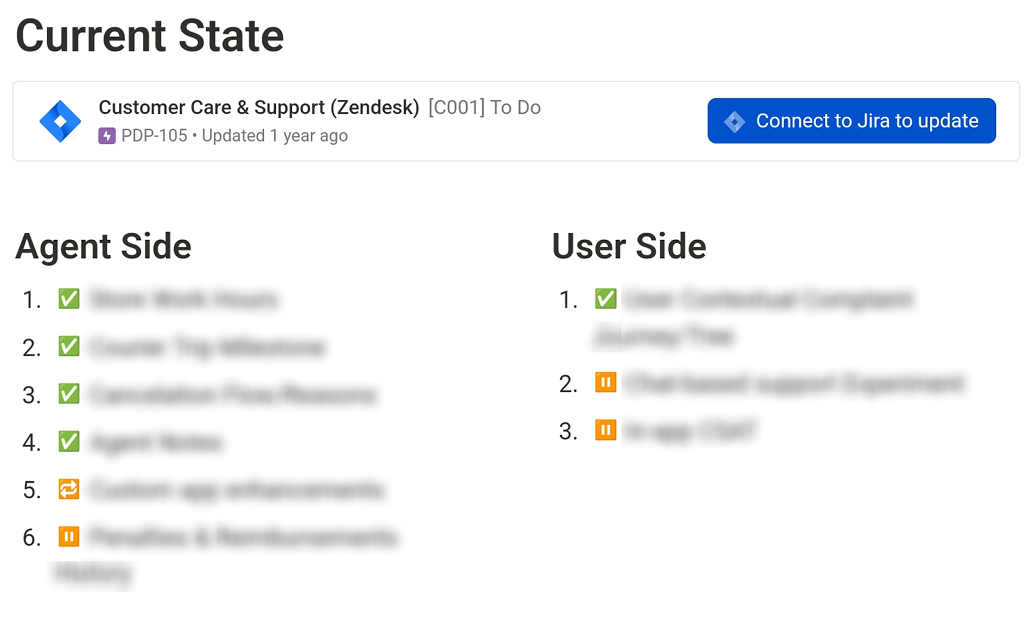
  • What’s already being addressed
  • Where efforts are fragmented
  • What urgent vs long-term needs exist
Ongoing support pipeline

🧱 Structuring the Roadmap System

Transformed roadmap from a list of tasks → structured decision-making system, enabling better visibility, prioritization, and cross-team alignment.

1. Build Project Definition Template

Designed a standardized project framework in Notion to bring consistency across initiatives, including:
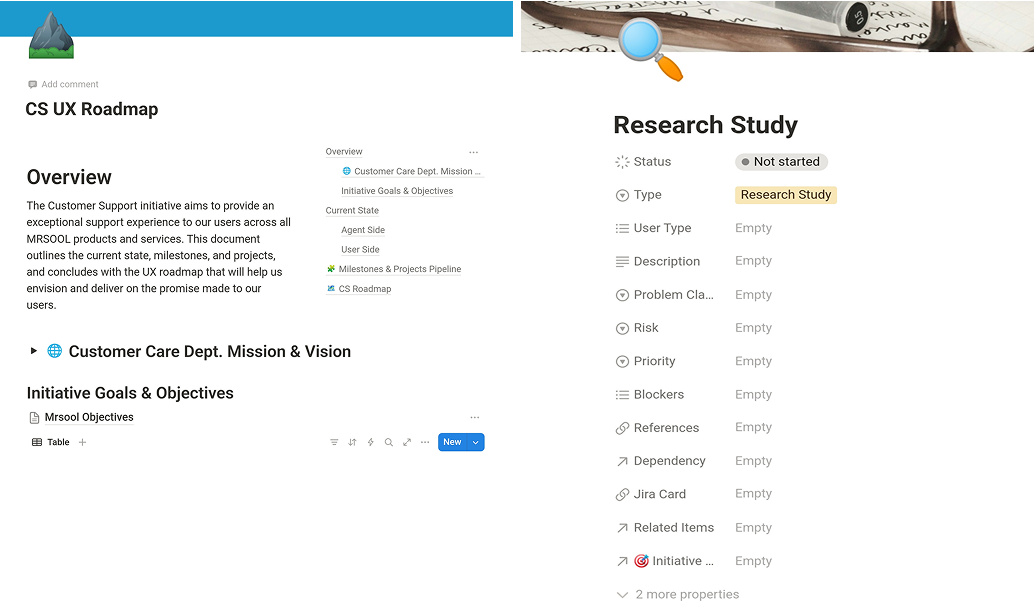
  • Project/Milestone Name
  • Challenge Summary
  • Project Type (Research Study, UI Tweaks, UX Project, Service Design Activity, Workshop, Design System)
  • Target User
  • Related Roadmap Initiatives
  • Related Initiative Objectives
  • Blockers (capacity gaps, resource needs)
  • Dependencies
  • Problem Clarity
  • Risk Level
  • Associated Jira Cards
Roadmap Project Templates in Notion
2. Define Priority

Prioritized improvements, focusing first on routing efficiency and agent workflows to unlock immediate operational gains. Prioritized projects using Jeanette Fuccella’s Prioritization Framework (2021):
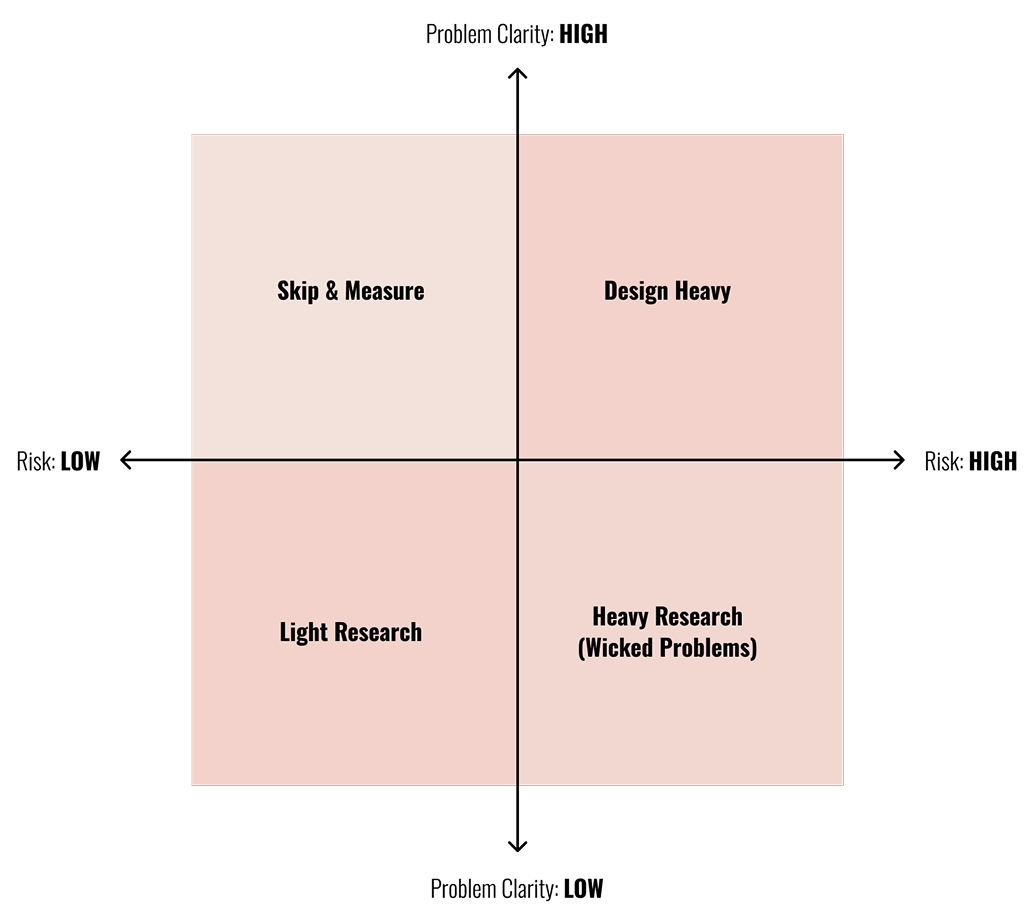
  • High Clarity + High Risk → Design Heavy
  • High Clarity + Low Risk → Skip & Measure
  • Low Clarity + Low Risk → Light Research
  • Low Clarity + High Risk → Heavy Research (Wicked Problems)
Priority Matrix
3. Create Roadmap Views

Built multiple roadmap views tailored to different stakeholders:
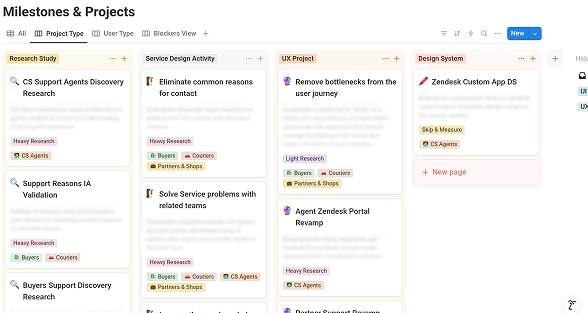
  • Default View (All Projects)
  • Project View (by Project Type)
  • User View (by Target User Group)
  • Blockers View (highlighting dependencies and critical paths)
Roadmap Views

This made the roadmap actionable and navigable for different teams, and enabled teams to understand dependencies and sequencing clearly

4. Populate Initiative Milestones and Projects

Defined a structured set of milestones and projects, each tied to specific service gaps and opportunities.
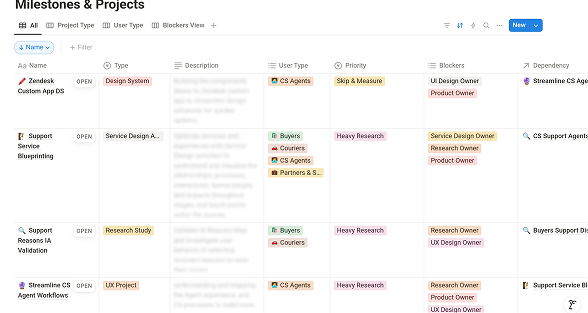
Milestones and Projects Roadmap

🤝 Alignment & Adoption

Facilitated design reviews with Product Design leads, and Product, showcased the roadmap to the broader Customer Support Initiative stakeholders for alignment in long-term strategic planning, setting a foundation for future enhancements and scaling efforts.


Disclaimer
This project is shared for portfolio purposes only. All rights, assets, and content belong to their respective owners.

Latest Work

See All Work
Cover of STC Wholesale illustration
Jan 2026

UX Audit: STC Wholesale Portal

Explores a hypothetical UX audit and redesign concept for a telecom wholesale portal, focusing on improving clarity, discoverability, accessibility, and B2B conversion experience.

Business Design
Design Research
Design Strategy
Oct - Nov 2022

Customer Support Workflows Workshops

Facilitated cross-functional workshops to deconstruct how support operates across user journeys. Transformed fragmented, tribal knowledge into a structured system of root causes, decision logic, and resolution flows, revealing gaps between product experience and operational reality.

Workshops and Facilitation
Service Design
Design Research
Cover mockup of person using mrsool app support home
Aug - Sep 2022

Contextual Complaints Journey

Complaints are often treated as isolated incidents—but in reality, they unfold as multi-stage journeys shaped by interactions, systems, and emotions. This project reframed complaints as a service journey, uncovering systemic breakdowns and transforming a fragmented, ticket-based model into a contextual, SLA-driven system—reducing resolution time and improving efficiency, clarity, and overall experience.

UX Design
Journey Mapping
Customer Experience (CX)

Connect and Collaborate 📩

Let’s talk and design whats next.

Thank you! Your message has been sent and will respond back shortly.
Oops! Something went wrong while submitting the form, Try again later.
arrow up